18th May 2020


It’s been a fairly productive week. I’ve kept on top of marking, organized upcoming Summer projects (some of which even pay!) and, most importantly, have completed a draft of my chapter for a forthcoming book on David Foster Wallace. Getting back into critical reading was a vital step, but it was still a very strange experience to be writing at this level, on a topic very close to my PhD research (but just different enough to require significant effort to reframe, especially on a very restricted wordcount). Getting these words on the page again is sparking all kinds of creative connections in my head. I’m feeling a bit manic about it all, simultaneously struggling to keep up with my thoughts and completely exhausted, what with all the global crises erupting all around. Thus, I’m loath to set any other deadlines, or even to really start something new. I don’t think I can handle simultaneous projects right now – going to try to get better at completing things sequentially for a change.

11th May 2020


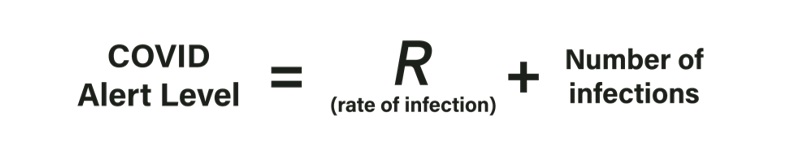
The whispers of change themselves can bring about such change. “Stay home” will be dropped and, without the rumour being addressed, it effectively was. For days it was allowed to hang in the air. And VE was used as an excuse to selfishly indulge in empty-calorie gratification with jingoistic pomp. Then, our baited breath was released when we were given “Stay Alert” …to what? Milhouse saw the whole thing happen. But the kicker, for me, was that wonderful example of Fashionable Nonsense was used to demonstrate how the “Alert Level” (which is either 1, 2, 3, 4, or 5) :

BadCovidFormula

While some have tried to argue that this is straightforward and intuitive, if you regard the relationship described as that in a complex plane, it is quite clear that a) this would need to be defined (which it isn’t); b) this would not be useful for a public-awareness infographic; and c) the formula was used to try to impress rather than inform. Yet, even considering popular interpretation, the relationship described by “+” is pretty analogically descriptive of the response to crisis so far: make irrelevant additions to turn incoherence into novelty.

Nevertheless, it has spurred me to start collecting, with greater energy, other examples of such mathematical representations of the current pandemic that abound in the media. Should we be fortunate to have the time and space to culturally analyse them, it would, I’m sure, make interesting reading.

4th May 2020


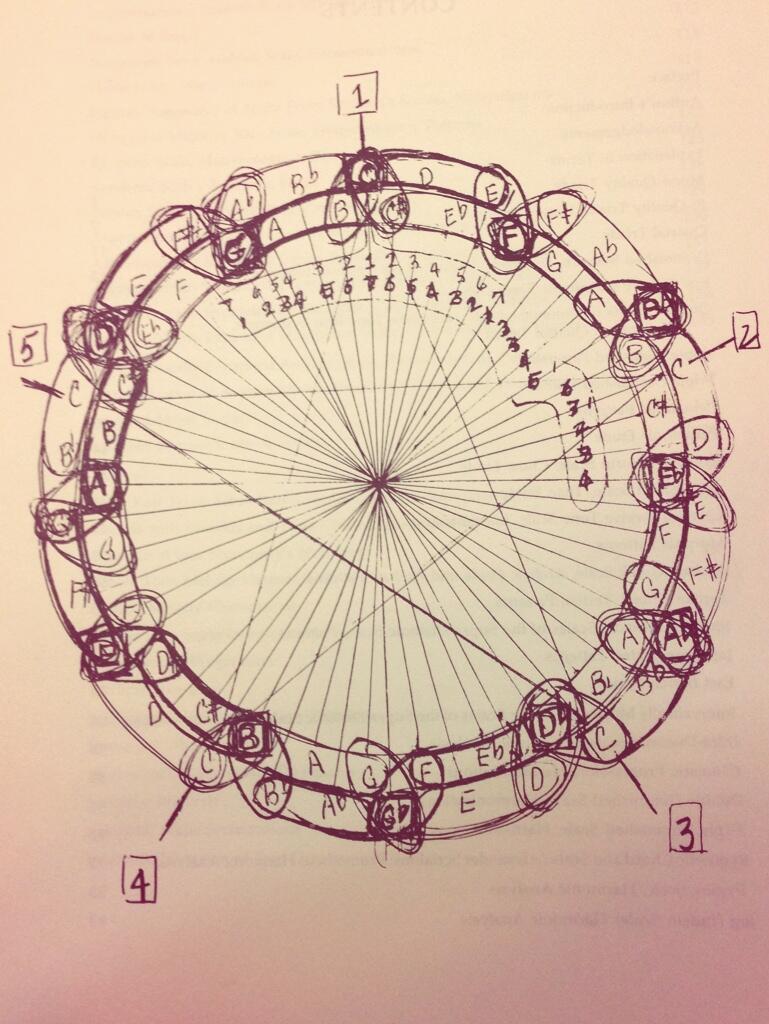
It is May and I have got round to some critical readings, (hooray!) albeit not the most immediately relevant. I’ve begun Stephon Alexander’s 2016 The Jazz of Physics: The Secret Link Between Music And The Structure of the Universe, which opens with that famous gloss by Einstein on his theory of relativity, “It occurred to me by intuition, and music was the driving force behind that intuition. My discovery was the result of musical perception”. Flicking through, I’m most interested in the diagram that John Coltrane gave to Yusef Lateef as a birthday present in 1961 – that modified circle of fifths mandala.


coltrane-circle-new

That’s about as far as I got. Thinking and writing clearly about music and mathematics is one of my favourite things to do – the clarity is something really special. But it feels a long way off, right now. Exhausted, and other marking and contractual uncertainties keeping me unproductive. And so, I’m done. Does this count as a post? A micro-post?

27th April 2020


I think I’m beginning to overcome a real funk and funky ennui that has made it very difficult indeed to work this past week. It may have been the sunshine – unseasonably hot, and in Glasgow of all places, especially in our little south-facing suntrap – which slowed everything way down, but it was also a shiftlessness. Kafka, 28th July 1914 : “I am more and more unable to think, to observe, to determine the truth of things, to remember, to speak, to share an experience; I am turning to stone, this is the truth”.  Although not nearly as bad as Kafka’s “Despairing first impression of the barrenness, the miserable house, the bad food with neither fruit nor vegetables” – we’ve got fresh veg delivered from the local grocer – 45 days in the same limited square footage has certainly turned me towards the stonelike. I’ve tried reflecting on my teaching practice and taken heart in returning to marking essays in order to reinvigorate through dialogue with students about texts I love and care about. I seem to be able to read fiction, albeit in very short bursts, but there has been a block in reading criticism. However, easy does it, that can be my small goal to achieve by the week’s end.

20th April 2020


I’ve been stunned beyond adequate reflection by the Orwellian propaganda drama coming out of the White House – meltdowns; cancelling funding to the WHO in the middle of a pandemic. This as the (unsurprising) news of UK leadership failures has finally been published, by The Sunday Times, no less! I managed to tear my eyes away from the news long enough to finally get round to watching Craig Mazin’s Chernobyl – incredible storytelling and way too resonant for today’s crises for comfort.


Despite the melancholic distractions, I calmed myself down from all this terror with another junction of maths and literature – a choral arrangement for a famous Biblical story (unnamed so I don’t get sued). Exploring the polyphonic arithmetic required to move from sombre Gregorian Chant to ecstatic four-part harmony with just four tenor voices, and manipulating the simple note arrangements on the staves is pretty soothing.


The past few days have also permitted some beautiful reading in the sun. I finished Saunders’s extraordinary Lincoln in the Bardo, and was particularly moved by the melancholy between worlds and unfinished business, note “A Heavy Bough Hung Down” – a song that evokes both Abel Meeropol’s ‘Strange Fruit’ (“Strange fruit hanging from the poplar trees”) and Joseph Beaumont’s Psyche or Love’s Misery, Canto II (Lust Conquered), 162:

Now those pageant beauties which of late

Had there trim’d up a Temple for Delight,

Were all unmask’d ; and Melancholy sate

Shrouding her hideous self in mid-day night.

The heavy nodding Trees all languished.

And ev’ry sleepy bough hung down its head.


This otherwordly delight has kicked me into getting through stacks of pleasure reading beyond some online-exam-prep work: returning to Morrison’s Beloved and Angelou’s I Know Why the Caged Bird Sings is liberating and devastating all over again, and is also helping reorient my own critical writing. While I’ve been picking away at a chapter on Wallace and Infinity, I should (cloudy weather permitting) be able to complete a draft, from the overwhelming notes, by next week.

13th April 2020


On this wonderfully sunny day, there is a moment of calm. Birds call out in song. Neighbours greet each other from a distance on their permitted daily walks. There is a chance to regroup. Many friends reaching out with projects to undertake – how to plan and carry out tutorials, guides, hang outs, pub quizzes and concerts. These events give us something both more and less. Relative deprivation, relative gratification.


Right now, in the taps-aff, vitamin-D-rich sunlight, I’m reading Ellmann’s Ducks, Newburyport, Vonnegut’s Cat’s Cradle, and Saunders’s Lincoln in the Bardo. There are lots of really interesting approaches to (moving through) space in these narratives that might benefit from a less alphanumerical mathematical framework. Something more intuitively topological, object-oriented, arrangements of (and in) fields and codes.


At some point, I’ll need to also get round to my lockdown reading list. But, with the library shut I’m going to have some trouble getting a hold of Arka Chattopadhyay’s Becket, Lacan and the Mathematical Writing of the Real (2019), Hanjo Berressem’s Eigenvalue and Michael Tonder’s The Physics of Possibility: Victorian Fiction, Science, and Gender (2018). Baylee Brits’s Literary Infinities: Number and Narrative in Modern Fiction (2018) would also have been really useful to have around right now as I try to maintain focus on writing my chapter on Wallace and Mathematical Infinity for Cambridge University Press. This alongside the book proposal and other CPD activities – HE fellowship applications, virtual learning, social-media networking. Of course, I feel that I have everything I need to work productively on all my writing and training: time, space, distractionless quiet…


And then I remember why that is and spiral: vacillating between emergency-supply shopping and side-hustles (to not starve or get evicted), brain-rot tv, and other mindless and necessary procrastinations (to not burnout and meltdown). Deprived and gratified – relatively speaking.

6th April 2020


As the lockdown and isolation continues beyond what must be the longest March I’ve ever experienced, virtual connection is proving to be the new norm. Which has its benefits. The David Foster Wallace Research Group is branching out and doing a group read of Lucy Ellmann’s Ducks, Newburyport. Really interesting experience – reminding me a lot of my time as an undergraduate on a James Joyce course. Now, of course, I’m blessed/cursed to be more attuned to the mathematical references. So, in response to her son’s maths homework, ‘the fact that as soon as I [the narrator] see[s] numbers in parentheses I kind of freeze up’, opens up this really interesting approach to mathematical (il)literacy and the emotional, affective responses it generates. There’s also much navigation/orientation around and between the narrator’s home and mind with numerical temporal markers – an important, rational inscription yet one constantly challenged (or in dialogue with) memory and other thought-trains.

I’m thinking too of Bergson’s ‘mathematical’ time, and of Tim Morton’s description of Husserlian transcendental reason as a ‘mathematiz[ing]’ force, inseparable from phenomenological experience.

Right now, I’m probably most interested in pursuing this in relation to music. Timbre and frequency. What Jason Robert Brown calls his ‘mathematical’ approach to structure and composition. The fact that all composers have the same limitations – how to arrange the same finite elements in each bar – and how these literally rational tools are how the musical problem is posed and how it is solved. At the same time, there is the rather more pedestrian understanding (a deceptive one) of those everyday mathematical applications: a cooking recipe; a calendar; a ‘personal best’ on a distance run or weight-lift. In short, lots of ideas brewing, and – now most of the marking is done and we’re still on lockdown – plenty of time to be reading. That said, some days are hard and, as is constantly pointed out, now is the time to become unshackled from frameworks of ‘productivity’. Nevertheless, I’m pleased that the PhD hasn’t completely obliterated my curiosity – after a little fallow period, new buds emerge.

30th March 2020

By yonde Betany, as Y yew telle,
Joachym wt schepardys dyd dwelle
Forty days and fowrty nyhyte,
Vnto he sey an angel brhyte.
By yonde ys a wyldernys of quarentyne
Wher Cryst wyth fastyng hys body dyd pyne,
In that holy place, as we rede.
The deuyl wold had of stonys bred

– William Wey, “Holy placis to Flum Jordan”, Itineraries, ([1470] 1857) p.14

Well, as a country we’re in almost-full lockdown now. “You should only leave the house for 1 of 4 reasons”:

  • shopping for basic necessities, for example food and medicine, which must be as infrequent as possible
  • one form of exercise a day, for example a run, walk, or cycle – alone or with members of your household
  • any medical need, or to provide care or to help a vulnerable person
  • travelling to and from work, but only where this absolutely cannot be done from home

These 4 reasons are exceptions – even when doing these activities, you should be minimising time spent outside of the home and ensuring you are 2 metres apart from anyone outside of your household.

From the back window, we can see those on their “one form of exercise”, passing each other on metre-wide paths, or those undertaking that emergency shopping trip – where they’d have to comply with distancing enforcement and queues to limit congestion: black-and-yellow-tape squares taking the art of queuing to new levels of orderly everyday fetish. We also see the police patrols exercising new wide-ranging powers of surveillance, command, and detention.

In this climate, it is very hard to get any kind of work done. I have two book chapter deadlines approaching, as well as a book proposal to redraft. And yet, the shear apocalyptic weight of it all makes it hard to think straight. I begin thoughts that trail off into stasis, walk into rooms and forget why; these suspensions broken by breaking news or innocuous memes that can send me spiraling. I can’t put my finger on it.

The earlier lockdown of university campuses embarked us on a frantic journey to online learning. This has meant continued disruption and anxiety for students and staff. Instead of a live performance, my lecture on Julia Phillips’s Disappearing Earth – some tentative probing of immediate thoughts, critical reading, and early research – is now exposed to all kinds of scrutiny and dissemination that normally would have been reserved for its published form. Meetings are now carried out through grainy portholes into homes that feature houseplants and housepets prominently. Emails with scary capitalisations – URGENT EMERGENCY CORONAVIRUS UPDATE – pour forth endlessly.

Off-campus, at the frontlines, trenches are dug and already bleak. Emotional and reasoned calls for medical volunteers jar with demands to keep each human ecology isolated. Loved ones in the fight at the hospital; loved ones in hospital, fighting. Shut the door; the draft will come.

And it is Spring. There is blue sky and sunshine.

23rd March 2020


My hand is cramped from getting used to handwriting again – personal events, thoughts, and feelings as we move to quarantine that is (at least at the time of writing) currently only self-imposed. From Twitter, I see this is the fashionable approach to Covid-19 house arrest. But, of itself, this kind of reflection really does ground you – helps you see clearly.


I’ve always struggled to keep a journal with any kind of regularity. This was especially the case during my doctorate. Despite being urged to do so, by various mandatory-training courses (most of which I missed because they did not pay, and I’d rather go make lattes for customers so that I could eat and stay homeful), I just didn’t connect with this ostentatiously egoistic conversation. One of the problems with my paper record keeping is my atrocious handwriting. My online efforts fared no better, not least because, in 2015, both my main and my backup laptops shuffled off this mortal coil. In fact, the netbook nearly took me with it, because its fan broke and it would regularly heat to almost 100 degrees Celsius: I recall a few nightmares of being engulfed while I slept, not-waking fused to cheap, melted plastic and precious metals. I was also broke as hell, so had to get my parents to front me some money to afford a new laptop (“are you in that dire straits that you don’t have £160 for a laptop?”; yes, yes I was). I was only able to pay them back, because my sister, working at a supermarket at the time (before her graphic-design career took off),  managed to get a double staff discount on the budget ‘everything machine’ – cheers, sis. On the 21st of November 2015, I tried to resume the online-diary practice:


“It makes you think, doesn’t it?” Uncle Colin asks rhetorically. We’re walking back from the KAOS production of Sister Act, in which my cousin/Colin’s nephew Anthony was playing the male lead. We’re talking about (gran)dad. He’s dying. Maybe a couple days to go – who knows? But yes, it does! To die with your family at your side is a blessing. To die without achieving your goals – tragic. This is what I “think”. My goals: a book, published, in my name. Whether criticism or fiction, I cannot say. But I know in my heart that finishing this PhD is absolutely essential. For what separates published writers from the wannabes: fundamentally, the drive, nay, the habit! to complete. the. manuscript! If I cannot do it under the (admittedly liberal) time/format-strictures of academia, how may I finish anything scaffold-less?

I know my path: lit. review, chapter by xmas; 2 chapters next year; revise in the summer as I visit the stateside archives; 3rd year writewritewrite. This is achievable – as millions before me have proven. I now have the drive and the means (technologically, in blue) to work like I’ve never worked before so that, with my heart’s last breath, I would say I’d given it my all.


And I did. I tried to pay no heed to my fatalistic dramatics. I got a routine. Grandad did die, as did others. The Order of Service so slight and fragile a document. Words on the page took on a new significance, more vital and enduring. And, I suppose, this is the place in which we now find ourselves.

16th March 2020


“[D]eeply concerned both by the alarming levels of spread and severity” of the novel coronavirus and its disease, COVID-19, “and by the alarming levels of inaction” of governments and their agencies, the World Health Organisation, on Wednesday 11th March 2020, “made the assessment that COVID-19 can be characterized as a pandemic”:


“Pandemic is not a word to use lightly or carelessly. It is a word that, if misused, can cause unreasonable fear, or unjustified acceptance that the fight is over, leading to unnecessary suffering and death.”


The television confirmed our dystopia. The same day, Harvey Weinstein was at last sentenced to 23 years in prison; after rapping to Sir Mix-a-lot’s ‘Baby Got Back’, ex-Governor of Alaska Sarah Palin removes her pink-blue bear’s head to reveal herself as the Masked Singer; and, following this and Tom Hanks’s confirmation of viral infection, Donald Trump misread his teleprompted address of flat-out coronavirus lies, appropriately, in the manner of a shortsighted zombie.


I also spoke with a final-year medicine student, whose graduation and start-date, he tells me, is likely to be rushed through as the NHS tries to cope with the explosion of demand that’s about to be unleashed. As inevitable nationwide government-imposed isolation looms – following Italy’s shutdown on 8th of March – my mind turns to the words of Dr. Wendy Beth Hyman (Oberlin): “We don’t choose what natural disasters, epidemiological emergencies, stock market crashes, tyrannical regimes, or wars our generations face. We only get to choose how we react.”


On the 8th November 2015, I recorded my feelings about approaching the halfway point of my PhD project. That I was supposed to have reached 50% completion was, at the time, terrifying. I had only a vague sense of the entirety of the dissertation: some kind of fusion of the history and philosophy of mathematics; the connection between mathematics and the imagination; how maths is specifically incarnated in the works of David Foster Wallace – see the equations and Cantorian tennis philosophy in Infinite Jest and the discussion of the limits and convergences of series in ‘Good Old Neon’ – as well as in those by his influences and contemporaries, specifically Don DeLillo’s Ratner’s Star (1976), Thomas Pynchon’s The Crying of Lot 49 (1966) and Gravity’s Rainbow (1973), Jorge Luis Borges’s ‘The Library of Babel’ (1941), ‘The Aleph’ (1949), ‘The Zahir’ (1949; 1974), and ‘The Book of Sand’ (1975), David Markson’s Wittgenstein’s Mistress (1988).


At that point, though, I still thought I was writing a ‘single-author’ thesis on Wallace. That was my Icarus-fated funding pitch and I was still irrationally tied to it. The research would not behave that way though and the thing was quickly bursting at the seams. So was I, actually, but I buried my head in the sand – taking on way too much paid employment that, even still, made me way too little on which to live and work. It was through great supervision that I realised the beast it was becoming, and that I needed to tame it. I’d find the solution much later. Structure, structure, structure. Form, form, form. I misunderstood those vital ideas as something old and stale, something unbecoming of creativity. And I wondered why the dissertation wasn’t working… At that point, at least, I was aware that I needed to change tack and, rather than continuing to type out massive quotes and a handful of half-baked pseudo-profundities, I had to spend my energies organizing, reorganizing, synthesizing what I’d thus far collected. This is what gave me headaches, late at night, after an exhausting minimum-wage shift, holed up in the shared office, in the dark, alone. Notes were spilling out everywhere, covering the desk, daring to be ordered, mocking me for failing.


A year later I’d be on a research trip to the Harry Ransom Center at the University of Texas at Austin, plunging through the archives of Wallace and DeLillo (and even coming across an abandoned music theatre project by one Thomas Ruggles Pynchon). That trip would clarify a few things, not least what it means to live in a freeway motel on a rather sketchy side of town. It’d also leave me with a paralyzing amount of data. I needed to be brutal. Cut without mercy. But then, what was left but a scattering of half-thoughts – crazy string-and-pin networks on a board? The whole globe-trotting aspect, while very exciting and adventurous, was part of the necessary humbling: feeling small in the face of the work, which in itself was tiny in comparison to all the work that would not, could not, be done. In the face of dramatic loss of life, this feeling has returned with a vengeance.


That I couldn’t make that trip today, with the U.S. cancelling all travel to and from the U.K. (as Trump eventually conceded that his golf courses at Doonbeg and Turnberry are essentially, fundamentally in Europe). Instead, I am holed up in Scottish containment: a rare, zen-pause in which to read and write.